27 June 2026
Open a Subsidiary in Australia
If you want to set up a company in Australia as a subsidiary, we invite you to contact our team of specialists for in-depth legal advice.

Our team can provide information on the tax benefits and obligations you will have when opening an Australian subsidiary, which is one of the options foreign companies have if they want to expand a business on the Australian market.
What is a subsidiary?
A subsidiary refers to a legal entity set up in Australia by a foreign company that acts as a parent. The parent must own the majority of shares of the subsidiary, which gives the parent the right to interfere in certain business matters of the subsidiary.
What legal entity is suitable for a subsidiary?
The subsidiary has to be registered under one of the legal entities that are prescribed by the Australian commercial legislation and in most of the cases, investors will have to decide between the public limited company and the private limited company. The decision should be based on the size of the company and the investment plans of the foreign businessmen.
| Quick Facts | |
|---|---|
| Best used for | Investors can open a subsidiary in Australia for the purpose of expanding their business operations overseas. The subsidiary is ideal for obtaining tax benefits applicable to local businesses (as it is incorporated as an Australian legal entity) and limiting the liability of the parent company and the business risks associated to expanding on a foreign market. |
Registration obligations for taxation | The subsidiary is required to: – obtain an Australian Company Number (ACN); – an Australian Business Number (ABN); – a TFN (Tax File Number); – register for GST (the Australian equivalent of the VAT). It must complete its tax registration procedures with the Australian Taxation Office (ATO) and submit tax reports in accordance with the current tax formalities. |
Minimum share capital | You can open a subsidiary in Australia with a share capital of minimum AUD $1 (there aren’t any capital requirements for incorporation, as long as there is a small share capital invested). |
| Publication fee | No publication fee (ASIC annual review fee for a proprietary company: $342 from 1 July 2026) |
| Penalties | Penalties are applied as a Failure to Londge (FTL) for tax returns, GST, PAYG (Pay As You Go) returns, etc. They are charged based on the size of the company (small, medium sized and large). |
| Management (Local/Foreign) | The management of the company can be foreign, but it it necessary to appoint a director who has Australian residency. |
| Legal representative requirements | In order to open a subsidiary in Australia, it is necessary to appoint 1 resident director. |
| Local bank account setup procedure | The investors will need to provide personal details, the registration details and documents of the parent company, the registration documents of the subsidiary in Australia, such as: – the company name; – the tax registration details; – the registered address in Australia; – details of the company’s directors. |
| Independence from the parent company | A subsidiary is an independent structure from the parent company, although the parent company holds the majority of shares. |
| Liability of the parent company | Limited to the amount invested. |
| Corporate tax rate | The standard corporate tax is of 30%, but a rate of 25% is available since 2021-2022 to companies that are base rate entities (aggregated turnover below $50 million and no more than 80% passive income). |
| Annual accounts filing requirements | – the PAYG – payroll reporting; – the BAS (business activity statement) on a monthly, quarterly or annual basis; – the GST report; – the IAS (instalment activity statement) – similar with the BAS, but applied to companies that are not GST payers; – the income tax report. |
| Possibility of hiring local staff (YES/NO) | Yes |
| Travel requirements for incorporating branch/subsidiary (YES/NO) | No |
| Number of double tax treaties signed by Australia (approx.) | 46 |
Why register a subsidiary in Australia in 2026?
The reasons for opening a company in Australia as a subsidiary can be influenced by numerous factors, regarding liability of the parent company, the preferred management structure, business plans and others, such as:
- one advantage of the subsidiary is that it represents a separate legal entity, with its own legal status, different than the one of the foreign company;
- the subsidiary is liable for its global income, but it can also benefit from various tax incentives and measures stipulated by the legislation in Australia, as it is an Australian based entity.
What are the steps of opening a subsidiary in Australia in 2026?
Below, our team of specialists in company incorporation in Australia have prepared a short description of the basic steps that you should follow in this case:
- register a suitable trading name for your Australian subsidiary;
- obtain an Australian Business Number and a Tax File Number, both necessary for trading activities in this country;
- register for taxation purposes – for the Goods and Services Tax, as well as for the Pay As You Go tax;
- the foreign company must also make sure to appoint a local representative that will be in charge for the Australian subsidiary;
- find a suitable office space where the company can have its official business address;
- open a corporate bank account for the Australian subsidiary and deposit the required capital (which will vary depending on the selected company type).
Are there any incorporation fees in Australia?
Foreign businessmen who want to open a company in Australia registered as a subsidiary or registered under another structure must know that they are required to pay specific processing fees. The registration of a company can cost minimum $524 in 2026. According to the information presented by ASIC, the registration fees charged by the institutions can increase up to $636.
What is the law regulating subsidiaries in Australia?
The basic rules for company formation in Australia for this structure, along with the rules for its functioning, are established under the Corporations Act 2001. The law provides the regulations for registration, reporting, governance, winding up, etc.
What are the rules on shareholders and directors?
If you want to open a subsidiary in Australia as a Pty. Ltd., please mind that it is necessary to appoint at least one director who has Australian residency and who must hold an Australian Director Identification Number. Shareholders can be foreigners (there aren’t any residency rules for them) and the entire shareholding structure can be made of foreign entities, as the subsidiary can be 100% foreign owned.
Are there any limits to the number of shareholders?
This depends on the selected legal entity. In all cases, the minimum accepted number is 1, and if the investors opt for the proprietary limited company (Pty. Ltd.), the equivalent of the limited liability company, then the maximum number of shareholders will be 50.
Below, you can see a short video on how to open an Australian subsidiary:

Do I need to appoint a secretary?
The company type of the subsidiary gives the rules concerning the appointment of a secretary. While in a Pty. Ltd. investors are not obligated to appoint one, in a public limited company, this requirement is a mandatory part of the process of company formation in Australia. In this case, at least 1 secretary must be appointed in the company and the person needs to be an Australian resident.
Can I use virtual office services for my company’s registered address in Australia?
Yes. Just as you can open a company in Australia that has its registered address at a preferred virtual office location, the subsidiary can do the same, regardless of the legal entity under which it is incorporated (a PO box is not accepted).
Do subsidiaries need licenses?
It depends on the industry in which the subsidiary will operate. For personalized information, we recommend you get in touch with our consultants specialized in company formation in Australia.
Do I need to register for Goods and Services Tax (GST) in Australia?
In most cases, Australian businesses are required to register for GST. This tax represents the equivalent of the VAT. The registration can be done on a voluntary or mandatory basis, and the type of registration must be made based on the GST turnover a company expects to reach. Investors must register for GST (registration is voluntary only below the threshold) if they expect to reach $75,000 as a turnover in their first year of business.
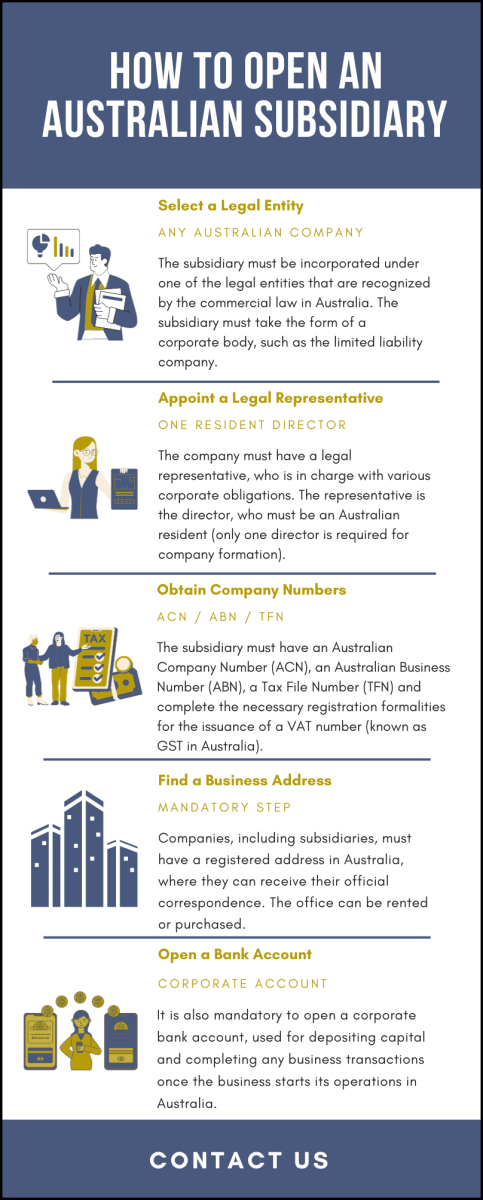
We invite you to read our infographic, presenting the main steps on how to open an Australian subsidiary:
What should foreign investors know in connection to the promotion of foreign investments in Australia?
In the list below, we invite you to discover some of the advancements made by the Australian authorities in relation to foreign direct investors:
- starting with 1st of January 2025, the Foreign Investments Review Board (FIRB), the entity in charge with foreign investment applications, introduced new regulations that were designed for the purpose of simplifying the application process;
- thus, starting with this date, FIRB aims at reducing the processing time to only 30 days for at least 50% of the applications received.
For more details, do not hesitate to contact our consultants, who can help you set up a company in Australia.